
Tracheostomy & Airway Surgery
Planned or urgent airway surgery for selected head and neck cancer patients, with clear guidance on tube care, speech and removal.
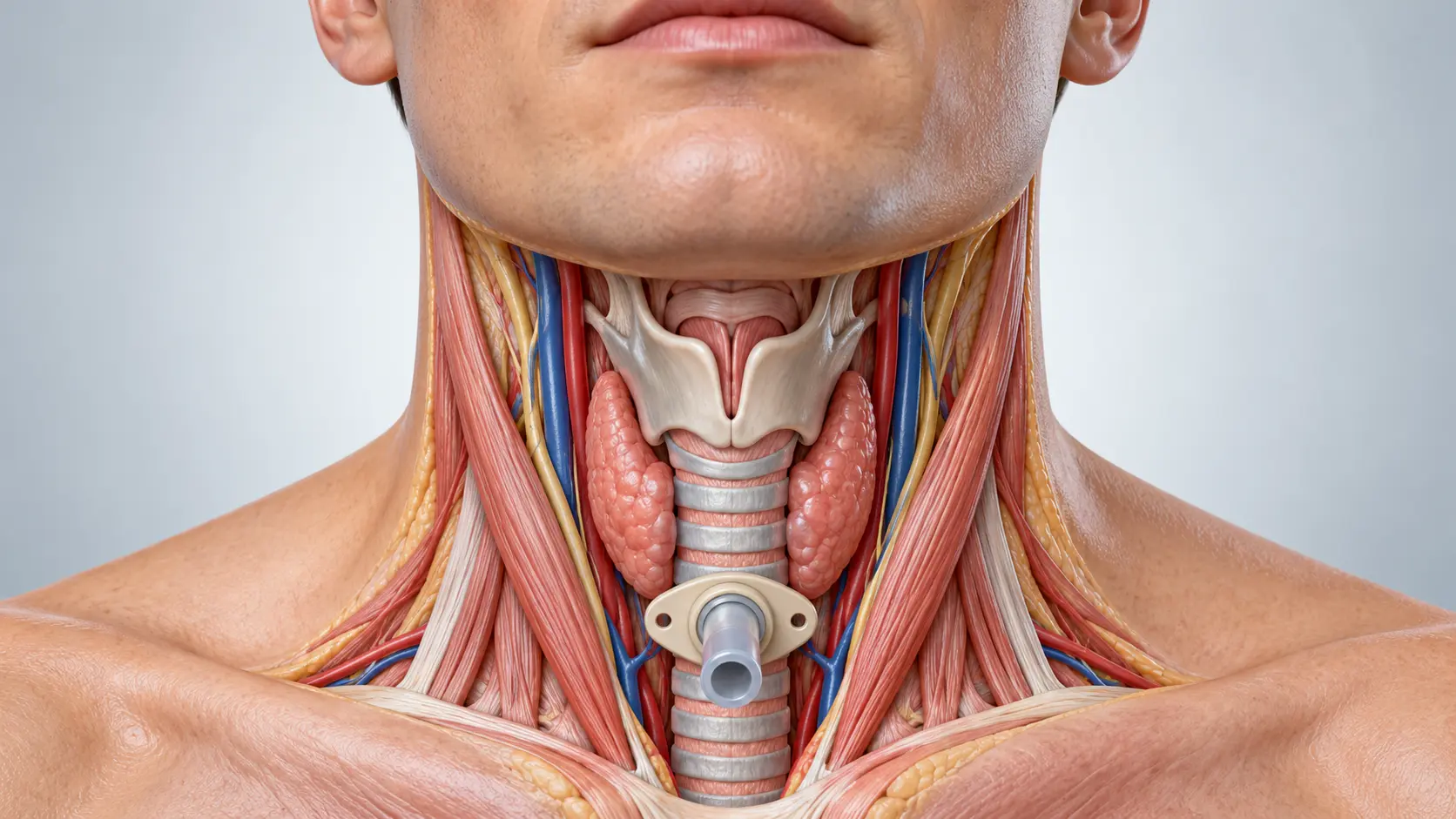
When protecting the airway becomes the first priority
Breathing comes before every other treatment objective. Tumours of the mouth, tongue, throat and larynx can narrow the airway, while swelling, bleeding or major surgery can also make breathing difficult.
In these situations, establishing a secure airway may become an essential part of treatment.
What is a tracheostomy?
A tracheostomy is a surgically created opening through the front of the neck into the trachea. A tube can then provide a direct pathway for air to enter the windpipe.
Depending on why it is performed, a tracheostomy may be temporary or long-term.
Why might a head and neck cancer patient need one?
01
Before cancer treatment
A tumour may significantly narrow or threaten the airway.
02
During major surgery
Postoperative swelling after complex oral, tongue, jaw or throat surgery may make a temporary tracheostomy advisable.
03
After treatment
Anatomical or functional changes may occasionally make longer-term airway support necessary.
A tracheostomy is not automatically permanent
The opening and tube may be temporary or longer-term depending on the original reason, the patient’s airway and recovery.
What happens during the procedure?
An opening is created into the trachea through the neck and an appropriately selected tube is inserted. In urgent circumstances, the priority is rapid establishment of a safe airway.
When planned, the procedure can be integrated into the overall operation and postoperative care.
Living with a temporary tracheostomy
- Humidification and secretion management
- Suctioning when required
- Cleaning and tube care
- Communication strategies
- Recognising warning signs
- Assessment of swallowing and aspiration risk where relevant
Can a patient speak with a tracheostomy?
Speech may be altered because airflow is redirected. Whether and how a person can speak depends on the underlying surgery, airway anatomy and type of tracheostomy.
Selected patients may use specialised speaking valves after assessment by the clinical team.
When can the tube be removed?
Decannulation is considered when the original reason has resolved and the patient can maintain a safe airway.
- Airway openness and swelling
- Breathing and cough effectiveness
- Secretion management
- Swallowing safety
Tracheostomy is different from laryngectomy
A tracheostomy creates an opening into the trachea while the larynx generally remains present.
A total laryngectomy removes the larynx and permanently separates the airway from the mouth and nose. The resulting neck opening is fundamentally different from a temporary tracheostomy.
Airway planning is part of cancer planning
- Can the patient be safely intubated?
- Could postoperative swelling compromise breathing?
- Is a temporary tracheostomy advisable?
- When can normal airway breathing safely resume?
URGENT WARNING
Breathing difficulty requires urgent medical attention
New or worsening breathing difficulty, noisy breathing or rapidly increasing throat or neck swelling can represent an airway emergency. Seek urgent medical assessment rather than waiting for a routine consultation.
COMMON QUESTIONS
Questions about tracheostomy & airway surgery
General information to help you prepare. A consultation is required for advice about an individual diagnosis or treatment plan.
Is a tracheostomy always permanent?
No. It may be temporary or long-term depending on why it was required and whether the airway becomes safe without it.
Can a person speak with a tracheostomy?
Speech may be altered, but selected patients can use specific communication strategies or speaking valves after clinical assessment.
When can the tube be removed?
Removal is considered when the airway is open, breathing and cough are effective, secretions are manageable and swallowing safety is satisfactory.
Is a tracheostomy the same as a laryngectomy?
No. A tracheostomy creates an opening into the trachea while the larynx remains present; total laryngectomy removes the larynx and permanently separates the airway.
Do you have new or worsening breathing difficulty?
Breathing difficulty, noisy breathing or rapidly increasing throat or neck swelling may be an emergency and requires urgent medical assessment.