
Oral Cancer Surgery
Treating oral cancer while protecting the functions that matter
Individualised surgical evaluation for cancers of the tongue, cheek, gums, floor of mouth, hard palate, lips and other oral-cavity sites.
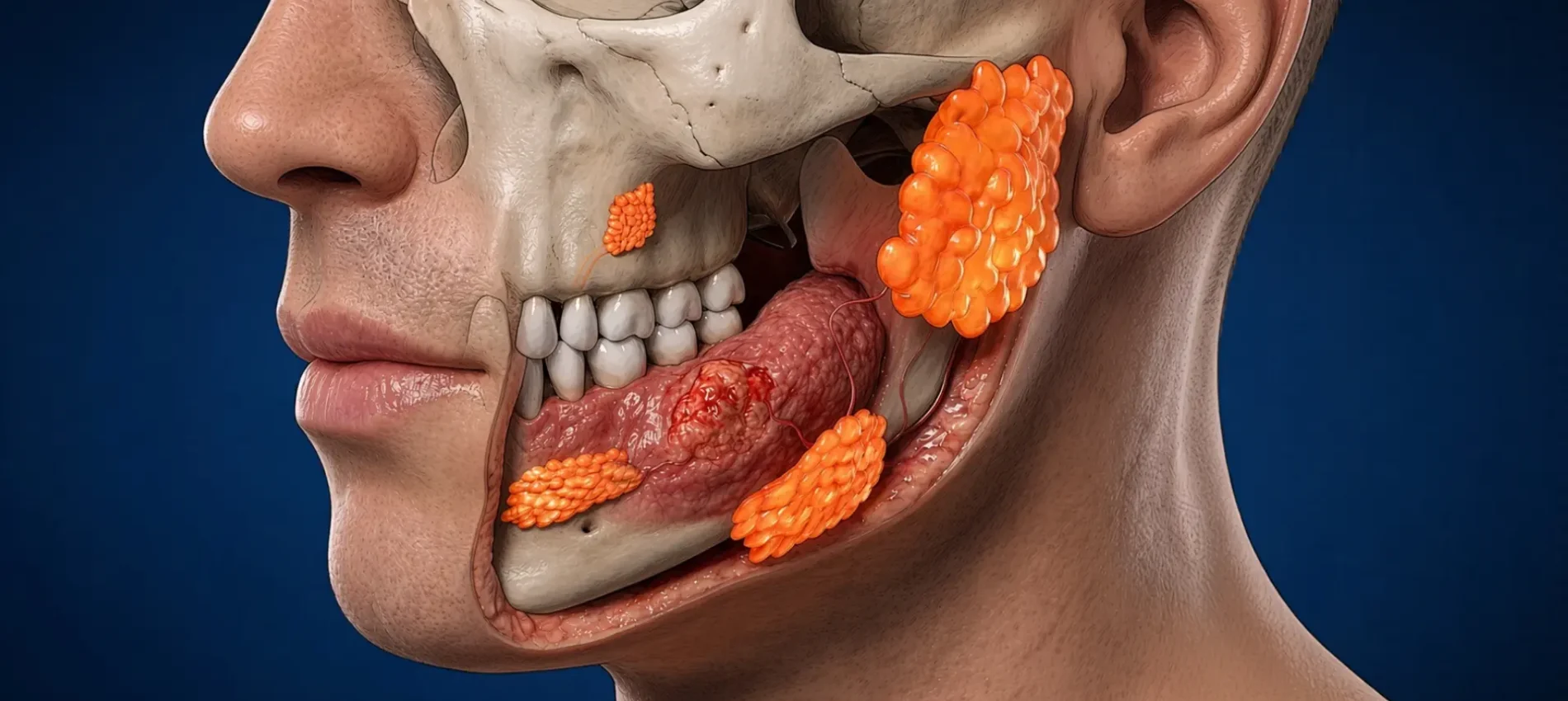
Treating oral cancer while protecting the functions that matter
Oral cancer affects structures we use every day to speak, chew, swallow, smile and communicate. Treatment planning therefore considers cancer control together with speech, swallowing, appearance and long-term quality of life.
Oral cancer may arise from the tongue, inner cheek, gums, floor of the mouth, hard palate, lips or other tissues within the oral cavity. The appropriate treatment depends on the tumour’s location, size, depth, lymph-node involvement, pathology and overall stage.
Dr Anup Srinivas provides surgical evaluation and treatment planning for oral and head & neck tumours, tailoring the surgical approach to the individual disease.
UNDERSTANDING THE DIAGNOSIS
What exactly is oral cancer?
Most oral cancers develop in the lining of the mouth. A suspicious lesion may initially look harmless, a small ulcer, red or white patch, thickened area or growth, but persistent changes need medical evaluation. The exact location influences how the cancer behaves and how surgery can be planned.
- Tongue
- Inner lining of the cheek
- Floor of the mouth
- Gums
- Hard palate
- Lips
- Retromolar region behind the last molar
WHEN TO SEEK AN OPINION
A mouth ulcer is not always “just an ulcer”.
Many common mouth ulcers heal naturally. A lesion that persists, repeatedly bleeds, becomes firm, enlarges or causes increasing discomfort deserves attention. Persistent symptoms should be investigated rather than repeatedly treated without establishing a diagnosis.
- A persistent mouth ulcer or growth
- Unexplained oral bleeding
- Difficulty chewing or swallowing
- Reduced tongue movement or numbness
- A lump in the neck
- Loose teeth without a clear dental reason
- An unexplained change in the way dentures fit
FROM SUSPICION TO DIAGNOSIS
A clear treatment plan begins with the right questions.
Evaluation establishes whether a lesion is cancerous, defines its local extent and considers lymph nodes or disease elsewhere.
- A persistent mouth ulcer or growth
- Unexplained oral bleeding
- Difficulty chewing or swallowing
- Reduced tongue movement or numbness
- A lump in the neck
- Loose teeth without a clear dental reason
- An unexplained change in the way dentures fit
01
Is the lesion cancerous?
A biopsy allows tissue to be examined under a microscope.
02
How large and deep is it?
Clinical examination and imaging help establish the local extent.
03
Has it reached nearby structures?
Imaging may assess deeper tissues or possible jaw involvement.
04
Are lymph nodes involved?
The neck is an important part of staging oral cancer.
05
Has disease spread elsewhere?
Additional imaging may be recommended according to stage and clinical findings.
WHEN SURGERY IS RECOMMENDED
The operation is matched to the individual cancer.
For many resectable oral-cavity cancers, surgery forms a major part of treatment. The procedure may range from removing a relatively small lesion to a more extensive operation combined with neck surgery and reconstruction.
01
Wide local excision
The tumour is removed with an appropriate margin of surrounding tissue.
02
Tongue surgery
A portion of the tongue may need removal when the cancer originates there.
03
Jaw surgery
Part of the jaw may be removed when tumour location or involvement makes this necessary.
04
Neck dissection
Selected patients require removal of cervical lymph nodes as part of cancer treatment.
05
Reconstructive surgery
After larger resections, reconstruction may help restore swallowing, speech and facial form.
WHEN SURGERY IS RECOMMENDED
Cancer removal and reconstruction are parts of the same plan.
In complex oral cancer surgery, reconstruction is planned alongside tumour removal, not as an afterthought. Skin, muscle, soft tissue and/or bone may be transferred from another part of the body to rebuild structures involved in speaking, swallowing and facial appearance.
The reconstructive method depends on what needs to be replaced. A small defect and a major tongue or jaw defect require very different solutions.
AFTER SURGERY
Healing continues beyond the operating room.
Early priorities include safe wound healing, pain control, nutrition and airway management. Depending on the extent of surgery, temporary feeding or airway support may be needed. Rehabilitation is planned around the functions affected by treatment.
01
Speech rehabilitation
Support to improve communication after tongue or oral-cavity surgery.
02
Swallowing rehabilitation
Guidance to help patients return to safe oral feeding.
03
Nutritional support
Support during healing and any additional cancer treatment.
04
Dental rehabilitation
Planning where teeth or jaw structures have been affected.
Will I need radiation or chemotherapy?
Not everyone does. Final surgical pathology provides information about tumour characteristics, margins and lymph-node involvement. The multidisciplinary team uses these findings to decide whether surgery alone is sufficient or whether additional treatment should be considered.
The complete treatment plan cannot always be predicted from the biopsy alone.
Life after oral cancer treatment
Follow-up allows the team to assess healing, speech, swallowing, nutrition and rehabilitation, while watching for recurrence or new disease.
For patients who previously used tobacco, gutkha, betel nut or similar products, permanent cessation is especially important.
COMMON QUESTIONS
Questions about oral cancer surgery
General information to help you prepare. A consultation is required for advice about an individual diagnosis or treatment plan.
Can early oral cancer be cured with surgery?
Many early oral-cavity cancers can be treated effectively, but prognosis depends on the site, stage, pathology and other individual factors.
Does oral cancer surgery always affect speech?
No. The effect depends mainly on the location and amount of tissue removed. Function-preserving surgery and reconstruction are considered whenever oncologically appropriate.
Does every patient require jaw removal?
No. Jaw surgery is considered only when tumour location or involvement makes it necessary.
Why are lymph nodes removed when the cancer is in the mouth?
Oral cancers can spread to cervical lymph nodes even though the primary tumour begins inside the mouth. Neck treatment is considered according to the individual stage and risk.
Concerned about a persistent mouth lesion?
A lesion that does not heal or continues to change deserves proper evaluation. Consult Dr Anup Srinivas for assessment and personalised treatment planning.