
Salivary Gland Tumours
A lump near the ear or jaw: what could it mean?
Assessment and surgical planning for parotid, submandibular, sublingual and minor salivary-gland tumours.
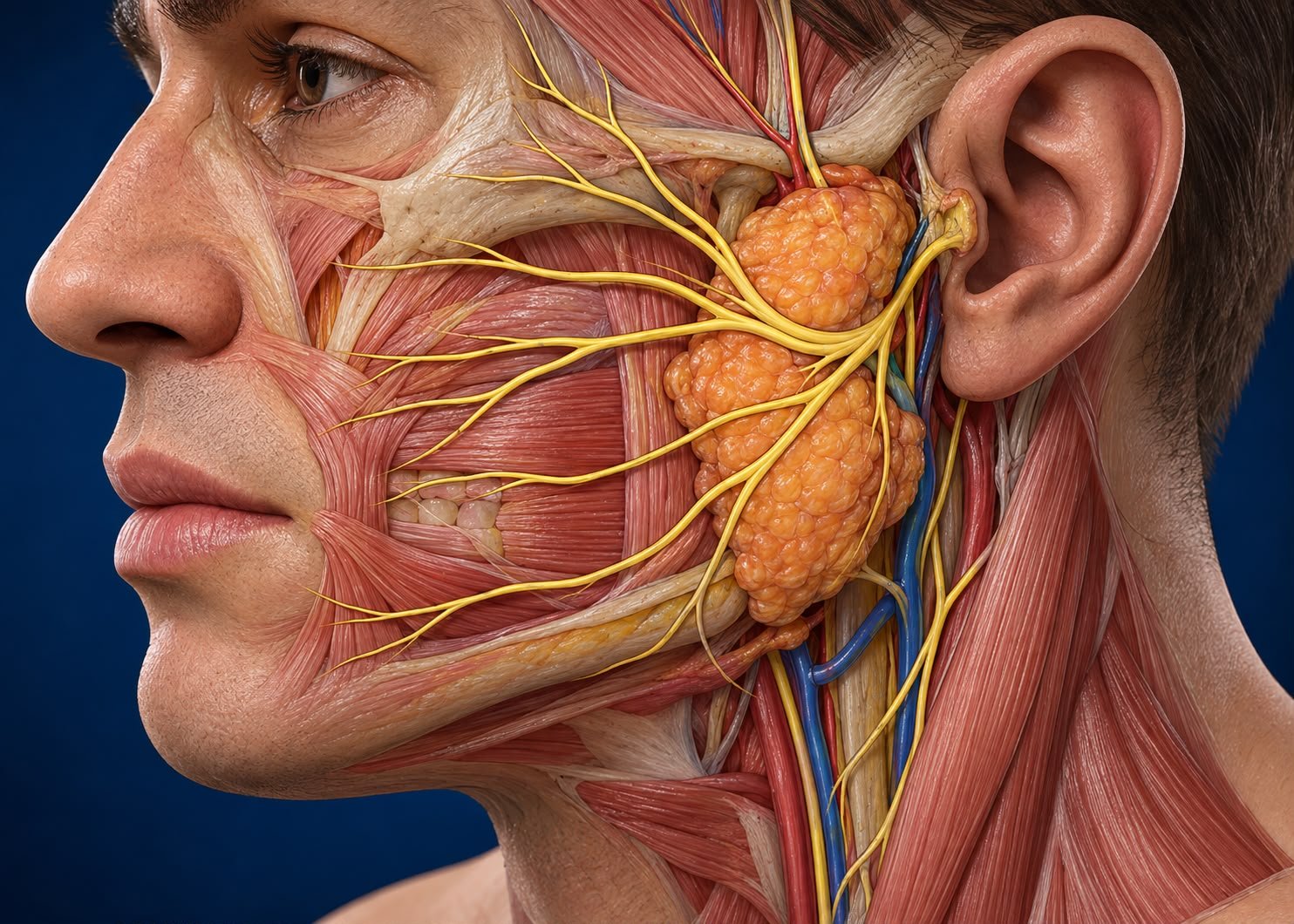
A lump near the ear or jaw: what could it mean?
A slowly growing lump near the ear, below the jaw or inside the mouth can originate from a salivary gland.
A salivary-gland tumour is not automatically cancer. These tumours include many pathological types and can be benign or malignant, so establishing the correct diagnosis is important.
Where do salivary-gland tumours develop?
01
Parotid glands
Situated in front of and below each ear.
02
Submandibular glands
Located beneath the jaw.
03
Sublingual glands
Situated beneath the tongue.
04
Minor salivary glands
Present throughout the mouth and throat.
FACIAL NERVE PRESERVATION
Why parotid surgery requires special expertise
The facial nerve passes through the parotid gland and controls many facial movements.
Parotid surgery therefore requires careful identification and management of the nerve while removing the tumour appropriately. Preservation of facial movement is an important objective whenever oncologically possible. If a malignant tumour directly involves the nerve, decisions can become more complex.
Signs that require assessment
- Persistent or enlarging salivary-gland swelling
- Pain, facial weakness or facial numbness
- Rapid growth
- Fixation to surrounding tissue
- Difficulty opening the mouth
- Enlarged lymph nodes
How the diagnosis is established
01
Clinical examination
Assessment of the mass, facial nerve function and neck.
02
Imaging
Ultrasound, CT or MRI may be used according to the location and clinical question.
03
Needle sampling
Cytology or biopsy may help identify the nature of the tumour.
Surgery depends on where the tumour lives
For a parotid tumour, surgery can range from removal of the affected portion of the gland to a more extensive parotidectomy according to pathology and extent.
Submandibular-gland tumours require a different surgical approach. Minor salivary-gland tumours are treated according to their exact anatomical location. Neck dissection may be added for malignant disease when indicated.
After surgery, pathology guides the next step
The pathology report is especially important because many different salivary-gland tumour types exist. Selected malignant tumours may require postoperative radiation or other oncological management.
- Exact tumour type and grade
- Margin status
- Nerve involvement
- Lymph-node involvement
- Other pathological risk features
COMMON QUESTIONS
Questions about salivary gland tumours
General information to help you prepare. A consultation is required for advice about an individual diagnosis or treatment plan.
Is every salivary-gland lump cancerous?
No. Salivary-gland tumours can be benign or malignant. The first step is to establish the diagnosis rather than make assumptions from the presence of a lump alone.
Why is facial movement discussed before parotid surgery?
The facial nerve passes through the parotid gland and controls facial movement, so its relationship to the tumour is central to operative planning.
How is a salivary-gland tumour investigated?
Assessment may include clinical examination, imaging and needle sampling, depending on the location and clinical findings.
Will radiation be needed after surgery?
Not in every case. The need depends on the final pathology, including tumour type, grade, margins, nerve involvement and lymph-node findings.
Have a persistent lump near the ear or jaw?
Consult Dr Anup Srinivas for surgical assessment and an individualised plan based on your diagnosis, imaging and clinical findings.