
Mandible & Jaw Cancer Surgery
Cancer removal and jaw reconstruction planned together to support facial form, chewing, speech and swallowing.
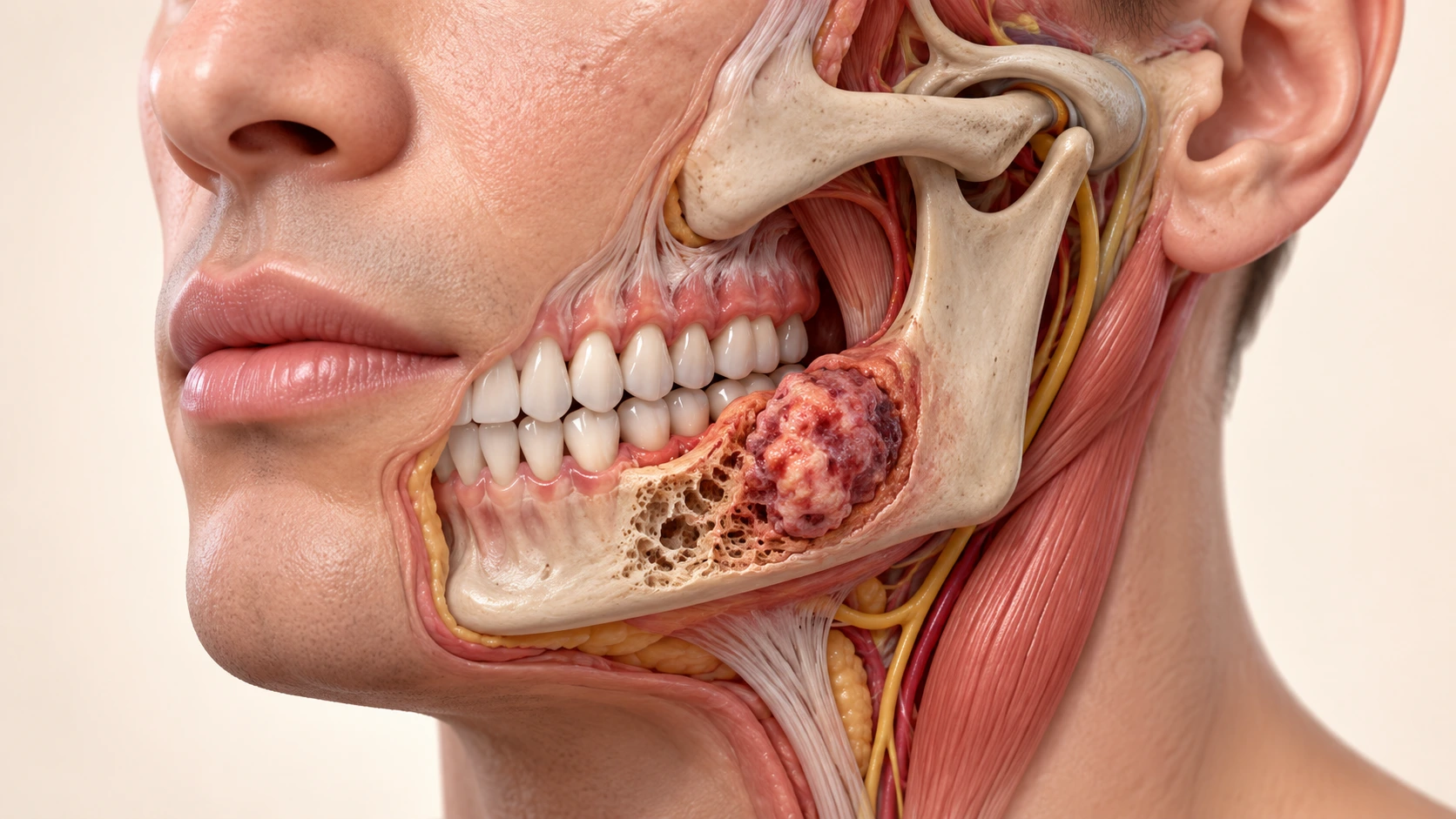
When oral cancer reaches the jaw
The lower jaw—or mandible—provides facial shape and supports chewing, teeth, speech and swallowing. Some cancers arise in or around it; more commonly, an oral tumour lies close to or extends into the bone.
Surgical planning connects two goals: remove the cancer adequately and preserve or reconstruct the jaw whenever appropriate.
Does every oral cancer near the jaw require jaw removal?
No. The extent of mandibular surgery depends on the tumour’s relationship with the bone. Imaging, clinical examination and intraoperative findings help determine the appropriate operation.
The extent of jaw surgery
01
Marginal mandibulectomy
In selected cases, part of the thickness of the mandible is removed while continuity of the jaw is maintained. This is considered only when oncologically appropriate.
02
Segmental mandibulectomy
When cancer extensively involves the mandible, a full segment may need removal. This interrupts jaw continuity and creates a larger functional and reconstructive challenge.
The operation does not end with bone removal
Loss of a major mandibular segment can affect facial symmetry, chewing, speech, swallowing, dental alignment and oral competence. Removal and reconstruction are therefore often planned as one operation.
How can the jaw be rebuilt?
Different defects require different solutions. Options can include reconstruction plates, bone grafts or vascularised bone-containing free flaps.
For major defects, microvascular reconstruction allows bone and associated soft tissue to be transferred and connected to blood vessels in the neck.
Fibula free-flap reconstruction
The fibula is one potential source of vascularised bone for mandibular reconstruction. A segment can be shaped to reproduce the contour of the missing jaw while its blood supply is reconnected microsurgically.
Not every patient requires or is suitable for this approach; reconstruction is individualised according to the defect and patient factors.
What happens to the teeth?
Dental rehabilitation should be considered as part of long-term planning. Depending on reconstruction, healing, radiation treatment and available bone, selected patients may later be evaluated for dental prostheses or implant-supported rehabilitation.
The immediate priority remains safe cancer removal and reliable reconstruction.
Recovery is a process, not a single event
01
Initial healing
Wound care, airway safety, nutrition and early recovery.
02
Functional rehabilitation
Speech, swallowing and jaw function are supported according to the operation.
03
Dental rehabilitation
Long-term planning may be considered after healing and oncology treatment.
04
Surveillance
Scheduled follow-up monitors healing and cancer control.
COMMON QUESTIONS
Questions about mandible & jaw cancer surgery
General information to help you prepare. A consultation is required for advice about an individual diagnosis or treatment plan.
Does every cancer near the jaw require part of the jaw to be removed?
No. The decision depends on the tumour’s relationship with the bone, assessed through examination, imaging and operative findings.
What is the difference between marginal and segmental mandibulectomy?
Marginal mandibulectomy removes part of the bone thickness while preserving continuity. Segmental mandibulectomy removes a full segment and interrupts continuity.
How can a removed jaw segment be reconstructed?
Options may include plates, bone grafts or vascularised bone-containing free flaps, depending on the defect and patient factors.
When is dental rehabilitation considered?
It forms part of long-term planning after safe cancer treatment, reliable reconstruction and appropriate healing.
Facing a complex jaw or oral cancer operation?
A detailed plan should explain both what needs to be removed and how function will be restored afterwards.